SEO Ranking Strategy Fundamentals: The Complete Guide
Quick Answer: For SEO ranking strategy fundamentals — The Complete Guide , a practical first target is 8 to 12 weeks for early ranking movement, with the…
Last updated: October 12, 2026
Quick Answer: For SEO ranking strategy fundamentals — The Complete Guide, a practical first target is 8 to 12 weeks for early ranking movement, with the clearest wins usually coming when intent, page type, and technical access align.
If you want higher rankings, the first question is not “What SEO tactic should I try next?” It is “What does Google need to see first for my page to deserve the top result?” The answer is a clear match between search intent, page quality, and authority signals, built in the right order.
What is an SEO ranking strategy?
An SEO ranking strategy is the plan for earning and keeping search visibility for SEO ranking strategy fundamentals by matching intent, improving page quality, and proving relevance and trust. That sounds broad because ranking is broad: Google’s own guidance says it uses many signals to assess relevance and usefulness, and no single trick wins on its own. A useful strategy decides what page should rank, why it should rank, and what has to happen before it can compete.
I would start with one simple rule: a ranking strategy is not a list of tactics, it is a sequence. If the page does not satisfy the query, no amount of links or technical cleanup will save it. If the site is technically blocked, the page may never get a fair chance. If the page attracts clicks but fails the searcher, it will not hold position for long.
That is why the fundamentals matter more than the latest SEO trend. The fundamentals are stable enough to survive core updates because they map to how search engines work at a basic level. Crawlers need access. Indexers need clear signals. Ranking systems need content that answers the query better than the alternatives. Users need a page that loads, reads well, and resolves the problem.
A good ranking strategy also has a scope. It is not for every business. If you sell something people never search for, or your market is tiny and relationship-driven, SEO may be a slow channel with poor fit. If your site already has strong brand demand, some ranking work will be maintenance rather than growth. The strategy changes with the business, but the fundamentals do not.
Which keywords should you target first?

You should target keywords where the search intent, your offer, and your current authority line up closely enough to win. A generic keyword list often fails because it confuses volume with opportunity. Ten thousand searches mean little if the page behind the query wants a product category page, while you only have a blog post.
I would sort targets into three groups. First, money pages: product, service, comparison, and pricing-intent queries. Second, support pages: informational queries that help a buyer understand the problem. Third, defensive or brand queries: searches for your name, your products, and common misspellings. The first group usually matters most for revenue, but the second group often creates the internal links and topical depth that help the first group rank.
The fastest way to waste time is to target keywords by difficulty score alone, because scores vary by tool and a number like 37 or 62 is not a plan. Instead, read the current SERP. Look at page types, content depth, freshness, and whether the results are dominated by brands, marketplaces, or local listings. A query that returns three comparison posts, two product pages, and one video tells you more than any generic metric.
I also like a practical filter: if a page could satisfy the query in one screen, it is usually a focused query. If it takes a full buyer journey to answer, it is likely a cluster topic. That difference matters because one page can often rank for the first, while the second needs supporting articles.
One common mistake is to skip low-volume phrases. Many of those phrases are the easiest wins, especially when they reflect a specific problem, model, location, or use case. They may not look impressive in a report, but they often bring the first visible lift.
How do search engines decide rankings?
Search engines rank pages by combining relevance, quality, and authority signals, then testing those pages against the query and the searcher’s likely intent. That is the simplest honest version. The exact weighting changes, but the structure stays stable.
Relevance starts with the query. A page needs the right vocabulary, the right entities, and the right content format. If someone searches “best running shoes for flat feet,” a page that only defines foot arches will not rank well, even if it is well written. The page must answer the searcher’s real task.
Quality is more than polished prose. It includes completeness, clarity, originality, and the usefulness of the page relative to the results already on page one. Google’s Search Essentials and Search Quality Rater Guidelines both point toward content that serves people first, not pages written to manipulate signals. That is why thin rewrites struggle.
Authority is where many ranking strategies get stuck. Authority is not only links, though links remain important. It also includes how much the site is trusted in its niche, whether the page sits inside a coherent topic structure, whether the brand is cited elsewhere, and whether the page earns engagement because it actually helps.
I would not treat any one factor as a switch; if a page has medical, legal, or financial implications, consult a qualified professional before relying on it, and review Google’s Search Essentials and Search Quality Rater Guidelines for the baseline. A technically perfect page can still fail if it covers the wrong intent. A brilliant article can stall if the site has no topical track record. A strong domain can rank a weak page for a while, but that is not a durable strategy. The winning pages usually align all three.
The practical takeaway is simple: do not ask, “How do I trick the ranking system?” Ask, “What combination of page type, content depth, site structure, and external trust makes this result the obvious choice?” That question produces better work.
What on-page SEO fundamentals actually move the needle?
On-page SEO moves the needle when it helps the search engine understand the page and helps the reader finish the task faster. Titles, headings, internal links, clean copy, and useful media all matter, but only when they work together.
Start with the title tag. It should promise the exact outcome the searcher wants without sounding stuffed. A title that says “SEO Ranking Strategy Fundamentals: The Complete Guide” is clear because it names the topic and the format. The title should not be clever at the expense of clarity. Searchers do not reward mystery.
Then use headings to create a map. Each H2 should answer a real sub-question, not repeat the same point in different clothes. If a page has a section on keyword targeting, another on page quality, and another on internal linking, that structure tells both readers and crawlers how the argument unfolds. Headings also help you avoid the most common failure in SEO content: one long paragraph pretending to be comprehensive.
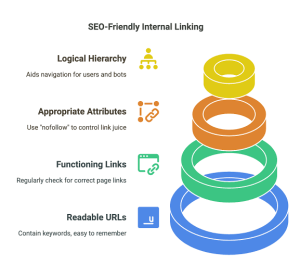
Internal linking is one of the most underused fundamentals. A strong internal link passes context as well as crawl paths. A page about SEO ranking strategy should point to related pages about keyword research, technical SEO, content briefs, and link acquisition. That network helps distribute authority and tells search engines which pages matter most.
Copy depth matters, but not in the “more words win” sense. The page needs enough detail to answer the query completely. For some topics that is 900 words; for others it is 3,000. This topic is the latter because the reader needs strategy, process, and trade-offs, not a checklist with three bullets.
For example, a cleaner page usually beats a heavier one when the query is precise. A useful page also avoids repetitive intro copy, vague claims, and clutter that slows understanding. That makes the page easier to trust and easier to index.
Why technical SEO is the foundation, not the finish line
Technical SEO is the foundation because it determines whether search engines can crawl, render, and interpret the page at all. It is not the finish line because a crawlable page can still be unhelpful, irrelevant, or untrusted. You need both.
The first technical check is indexability. If a page is blocked by robots.txt, noindexed, buried behind parameters, or trapped in a weak internal link structure, it may never compete. The second check is canonicalization. Duplicate or near-duplicate URLs can split signals and dilute the page you actually want to rank. The third is rendering. Heavy script dependencies can make content harder to process, especially if important text appears only after client-side execution.
Page experience matters too, though not as a magic ranking lever. Google has said Core Web Vitals are part of page experience signals, and that fits common sense: if a page shifts while loading or stalls for several seconds, people leave. Good technical SEO reduces that friction. It should not be mistaken for a substitute for content quality.
Structured data can help when used honestly. Product, article, FAQ, and organization markup can clarify page type and support rich results where eligible. It will not force rankings, and it will not rescue thin content. I would use it to remove ambiguity, not to chase gimmicks.
This is also where many site owners overspend. They fix 40 technical issues and expect the rankings to jump. Sometimes they do. Often, the site simply becomes eligible to compete. That is progress, but it is not the same as winning. Technical SEO gets the race started; it does not cross the line.
What most SEO ranking strategies get wrong
Most SEO ranking strategies fail because they start with tactics instead of diagnosis. They publish content before reading the SERP, chase links before fixing page intent, or optimize titles before the site can actually be crawled. The result is activity without direction.
The first wrong turn is ignoring intent match. A page can be beautifully written and still lose if the searcher wanted a tool, a list, a calculator, or a local service page. That mistake is expensive because it creates content that looks productive while missing the result.
The second wrong turn is over-valuing volume. A keyword with 20,000 monthly searches is often harder to rank for than ten smaller queries that fit the same business model. I would rather own five pages that answer distinct commercial questions than one broad page that tries to do everything and satisfies nothing.
The third wrong turn is treating links like a standalone fix. Links help, but they do not make irrelevant content relevant. They do not turn a thin page into a useful answer. They do not replace topical depth. That is why link-building campaigns often disappoint when the underlying page is weak.
The fourth wrong turn is publishing without a maintenance plan. Ranking pages decay. Competitors update. Search intent shifts. Product lines change. If a page is not reviewed, its ranking can slide even when it once performed well.
This section is the honest limitation: SEO is not for people who need immediate demand. If you need traffic this week, paid media is usually faster. SEO compounds, but slowly. That trade-off is real, and pretending otherwise is how teams waste quarters chasing a channel that was never meant to solve a short-term problem.
What went wrong in a typical ranking effort, and what did it cost?
The biggest failures usually come from misaligned priorities, and they cost months of work rather than one bad page. A common pattern is this: a team ships ten articles in March, discovers in May that the wrong pages were published, and only then realizes that the real ranking gap was not content volume but page type and internal linking.
The cost is not just time. It is opportunity. Every weak page published to the wrong query consumes editorial budget, designer time, review cycles, and link equity that could have supported a page with a real chance to rank. It also makes later diagnosis harder because the site now has more clutter than signal.
One frequent setback is technical debt hidden by brand strength. A site can rank in spite of poor structure for a while, then lose traction when competitors improve or when the search engine re-evaluates the page. At that point, the site owner blames the update, when the real issue was never repaired. The update only exposed it.
Another setback is the “publish and pray” model. The page goes live, gets no internal links, is never refreshed, and accumulates no external references. After 60 to 90 days, the team concludes that SEO does not work. In reality, the page was never positioned to compete.
I think this is the most important warning in the whole guide: ranking strategy fails quietly. It does not usually fail with a dramatic penalty. It fails by drifting down one position at a time, by losing clicks to a better title, by being outmatched by a clearer answer, by becoming stale. That is why measurement and review matter.
If you want the blunt version, here it is: the cost of bad SEO is not only wasted traffic. It is wasted confidence. Teams that repeatedly ship the wrong work stop trusting SEO as a channel, even when the channel is still valuable.
How do you build a ranking strategy that can actually hold position?
You build a ranking strategy that can hold position by connecting query research, content design, technical health, and authority-building into one plan. The plan should start with the highest-intent pages, not the easiest ones, and it should give every target page a clear role in the site.
I would use a four-part framework.
First, choose the page type. Decide whether the query needs a guide, a service page, a category page, a comparison, or a tool. If the page type is wrong, the rest of the work is wasted.
Second, map the subtopics. Identify the questions that must be answered for the page to feel complete. Those become headings, supporting examples, and internal links.
Third, remove technical blockers. Confirm the page is indexable, canonicalized, internally linked, and fast enough to read without friction. Use Google Search Console and a crawler such as Screaming Frog or Sitebulb to spot problems rather than guessing.
Fourth, build proof. That may mean links from relevant pages on your own site, citations from respected external sources, mentions in industry publications, or first-party evidence such as product specs, process details, or original analysis. The page should not merely assert credibility; it should show it.
The best ranking strategies are patient and boring in the right ways because they do not rely on one viral article, one link placement, or one technical fix. They create a system where each improvement supports the next one. That is how a page keeps ranking after the first spike fades.
What should you measure, and when should you expect movement?
You should measure rankings, clicks, impressions, indexed pages, internal link coverage, and conversion actions over at least 8 to 12 weeks before making a hard judgment. That timeline matters because SEO changes often show in stages, not all at once.
Start with Google Search Console. It tells you which queries trigger impressions, where clicks are starting to appear, and whether a page is gaining visibility even before rankings look impressive. Pair that with analytics so you can see whether traffic quality improves after the page starts earning impressions.
I would not judge a page only by position. A result that moves from page three to the bottom of page one can be a real win even if it is not yet the top spot. Likewise, a ranking spike without clicks may mean the title or snippet is weak. Measure both visibility and behavior.
The useful metrics depend on page type. For a product page, conversions and assisted conversions matter. For a guide, scroll depth, internal clicks, and newsletter signups may matter more. For a local page, calls and form fills may matter most. Rank is only one signal in a broader outcome chain.
A practical cadence helps. Review technical issues monthly. Review content quality and intent match every 6 to 8 weeks. Reassess keyword targets quarterly. Refresh top pages before they become stale, not after traffic falls off a cliff. That rhythm is slower than most teams want, but it is close to how durable SEO actually works.
SEO ranking strategy fundamentals: the short version
SEO ranking strategy fundamentals are about choosing the right page for the right query, proving that the page is the best answer, and removing anything that blocks search engines or users from trusting it. If you get the page type wrong, nothing else matters. If you get the content right but ignore technical access, the page may never compete. If you chase rankings without measuring clicks and conversions, you can win visibility and still lose the business outcome.
I would trust a simple rule over a clever hack: rank pages that answer a real search need better than the alternatives, then keep improving them. That is slower than shortcut SEO, but it lasts longer and breaks less often.
Key Takeaways
- Start with intent, not volume. The best keyword is the one that matches the page type you can realistically win.
- Treat SEO as a sequence: page type, content depth, technical access, then authority.
- Use internal links to tell both readers and crawlers which pages matter most.
- Do not confuse technical fixes with ranking success; they remove barriers, they do not create relevance.
- Expect movement in stages over 8 to 12 weeks, not overnight.
- If a page fails, check intent match before blaming links or titles.
FAQ
How long does SEO usually take to show results?
Most pages need several weeks to show early movement, and 8 to 12 weeks is a reasonable window before judging the direction of the work. For SEO ranking strategy fundamentals, that is the timeframe most teams should plan around.
Do backlinks still matter for rankings?
Yes, but they work best when the page already matches intent and the site has clear topical structure. Google’s Search Essentials also emphasizes helpful, people-first pages.
Should I optimize for one keyword or many?
One primary query with closely related subtopics is usually better than trying to force a page to rank for too many unrelated searches.
Is technical SEO more important than content?
No. Technical SEO removes barriers, but content relevance and usefulness are what usually determine whether a page deserves the ranking.
What is the first SEO fix I should make?
I would start by checking whether the page is indexable, matches the search intent, and has a title that clearly promises the right outcome.
Drafted with AI; not yet reviewed by a person.